
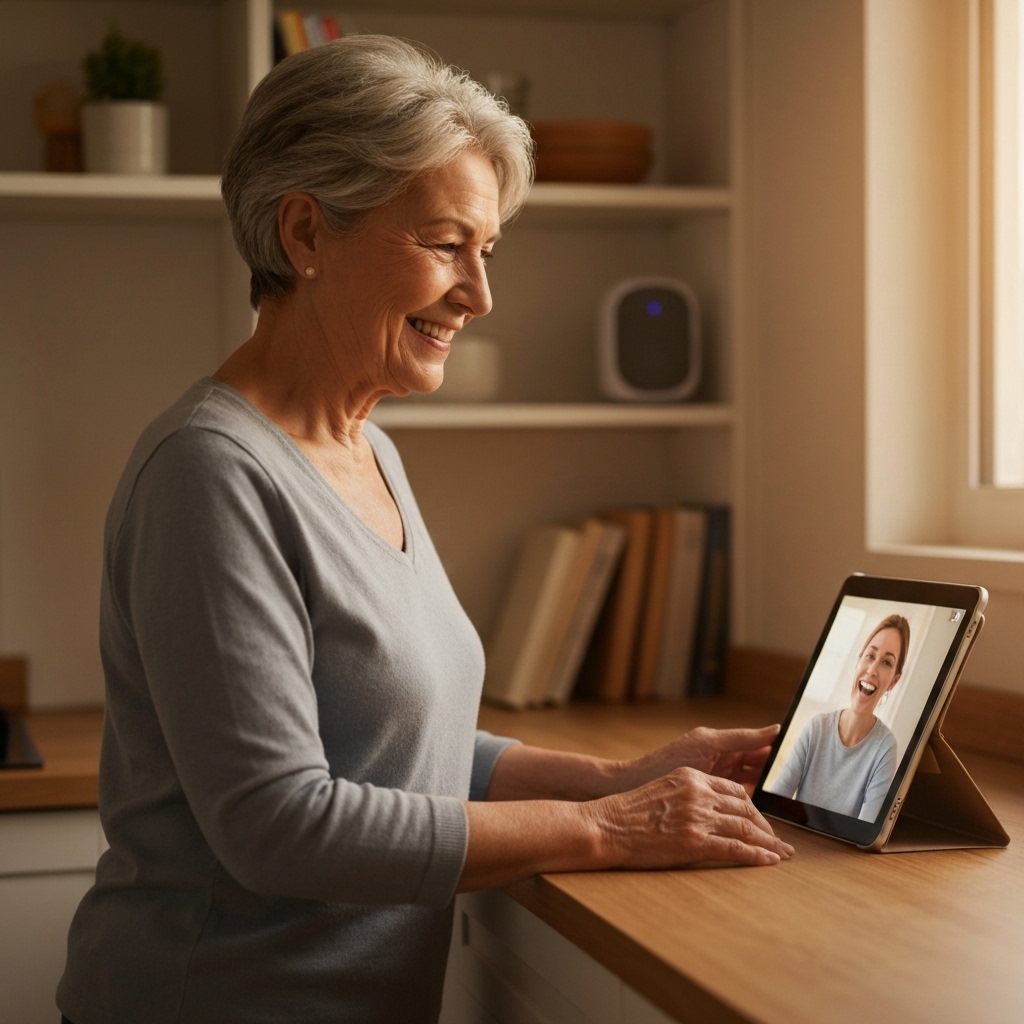
Why Voice Technology Is Reshaping Elder Care
Voice-activated assistants for seniors are genuinely changing what independence looks like for older adults. A single spoken word can now set a medication reminder, adjust the heating, or connect a grandparent with family across the country. That matters.
Yet the technology that promises connection is still failing millions of people. According to the World Health Organisation’s 2021 Advocacy Brief on Social Isolation, social isolation and loneliness affect around 1 in 4 older adults globally. It’s a silent epidemic, and mainstream technology is often making it worse rather than better.
Complex devices, confusing interfaces, and the assumption that every user can speak clearly or remember commands continue to exclude the people who need connection most. Voice assistants represent a meaningful step forward. However, they aren’t sufficient on their own, particularly for seniors living with dementia, hearing difficulties, or severe mobility challenges.
This guide covers what voice-activated assistants can realistically do, what the research actually says, where the technology still falls short, and how families and care teams can build a complete connection ecosystem that genuinely works.
In This Article
- Key Highlights at a Glance
- What Are Voice-Activated Assistants for Seniors?
- How Do Smart Speakers Help the Elderly?
- Alexa, Google Home, and Smart Speakers Compared
- What Is the Best Voice Assistant for Seniors?
- Can Alexa Call 999 or 911 for Seniors?
- What the Research and Health Authorities Tell Us
- Comparing the Market: JubileeTV, Komp, and the Gaps
- BondNow: Where Hands-Free Connection Goes Further
- How to Choose the Right Setup
- Conclusion
Key Highlights: Voice Assistants and Senior Independence at a Glance
- Voice-activated assistants for seniors reduce isolation and support daily independence without requiring technical knowledge from the user.
- Smart speakers for elderly independence, including Alexa and Google Home, offer reminders, hands-free calls, and home automation. However, they still require initial setup and reliable voice interaction.
- Senior autonomy tech delivers the strongest outcomes when the elderly person needs to do nothing at all such as auto-answer video calling platforms.
- Families and care homes that combine voice assistants with dedicated passive-connection platforms consistently report better resident wellbeing and reduced caregiver anxiety.
- No single device solves everything. The most effective approach layers voice control for safety with human presence for connection.
What Are Voice-Activated Assistants for Seniors?
Voice-activated assistants are devices that respond to spoken commands using natural language processing. There’s no screen tapping, no passwords, and no need to navigate menus. You simply speak, and the device responds.
The most widely used platforms are Amazon Alexa (on Echo devices), Google Assistant (on Nest devices), and Apple’s Siri (on HomePod). Each can play music, answer questions, set reminders, make calls, and control compatible smart home devices.
How Natural Language Processing Enables Hands-Free Living
Natural language processing means the device understands conversational phrases rather than rigid commands. A senior doesn’t need to say “Set timer 20 minutes.” They can say “Remind me to take my tablets in 20 minutes” and the device understands. This flexibility is what makes voice assistants genuinely accessible for many older adults.
Furthermore, NHS Digital’s technology-enabled care guidance recognises voice-controlled devices as a practical support tool for older adults living at home, particularly for medication adherence and daily routine management.
Common Use Cases: Reminders, Calls, and Emergency Alerts
- Medication reminders: Scheduled verbal prompts at set times each day
- Hands-free phone calls: “Call my daughter” triggers a call without touching a phone
- Weather, news, and information: Keeping seniors mentally engaged and informed
- Smart home control: Adjusting lights, heating, and door locks without physical effort
- Music and radio: A simple but meaningful source of comfort and cognitive stimulation
Who Benefits Most: Independent Seniors vs. Those in Residential Care
Fully independent seniors who are tech-curious often adapt well to voice assistants. The real challenge arises with those living with dementia, significant hearing loss, speech difficulties, or severe mobility challenges. These individuals may not reliably issue commands. For them, passive technology where the connection happens without any action required is far more effective.
How Do Smart Speakers Help the Elderly?
Smart speakers help elderly adults in four core ways: maintaining daily structure through reminders, enabling hands-free communication with family, supporting safe independent living through home automation, and providing cognitive and emotional stimulation through music, information, and conversation.
The Alzheimer’s Society highlights that predictable daily routines and familiar voices significantly reduce anxiety and confusion in people living with dementia. When configured correctly, smart speakers can reinforce these routines consistently and without staff involvement.
In addition, voice control home automation gives seniors genuine independence over their physical environment. Turning off lights, unlocking a door, or adjusting the thermostat without getting up reduces fall risk and preserves dignity. These aren’t small improvements; for many older adults, they’re life-changing.
Smart Speakers and Elderly Independence: Real Benefits, Honest Limitations
Alexa for Seniors: Benefits, Features, and Honest Limitations
Amazon’s Alexa offers some of the most developed senior-focused features on the market. Key benefits for older adults include:
- Medication and appointment reminders via scheduled verbal alerts
- Drop In calling, which connects family members almost instantly without requiring the senior to answer
- Alexa Together, a family dashboard allowing adult children to monitor activity, set reminders remotely, and access an urgent response line
- Smart home compatibility with thousands of devices including lighting, heating, and security
- Simplified routines that chain multiple actions to one command (for example, “Good morning” triggering lights, radio, and a weather update simultaneously)
However, Alexa still requires initial Wi-Fi configuration, an Amazon account, and ongoing management from a tech-confident family member or carer. Accent sensitivity and background noise can also cause voice recognition failures, which is frustrating and potentially dangerous for seniors relying on it for daily support.
Google Home for Older Adults: Where It Excels and Where It Struggles
Google Home, particularly the Nest Hub display range, brings a visual element to the equation. The screen shows photos from family, displays video calls with large, clear images, and can show step-by-step reminders visually as well as verbally. For seniors with partial hearing loss, this visual reinforcement is valuable.
Google’s routine automation is powerful and seamless. However, like Alexa, Google Home requires Wi-Fi setup, a Google account, and ongoing technical management. The Nest Hub’s voice recognition can also struggle with softer or less distinct speech patterns common in older adults.
Voice Control Home Automation for Seniors: Safety and Comfort Without Physical Strain
Beyond communication, voice control home automation for seniors offers real safety benefits. Smart lighting that activates verbally (or automatically at night) significantly reduces falls, which remain the leading cause of injury-related hospital admissions in older adults according to the NHS. Smart thermostats prevent cold-related illness. Smart door locks remove the need to manage physical keys. These aren’t luxuries for seniors living at home. They’re practical safety nets.
What Is the Best Voice Assistant for Seniors?
There’s no single best voice assistant for every senior. The right choice depends on the individual’s living situation, cognitive ability, and how much ongoing technical support the family can provide.
| Platform | Best For | Key Limitation |
|---|---|---|
| Amazon Alexa (Echo) | Reminders, family monitoring, smart home control | Requires setup and ongoing management; cannot auto-answer calls |
| Google Assistant (Nest Hub) | Visual display, seamless calling, routine automation | Accent sensitivity; Google account required; setup complexity |
| Apple Siri (HomePod) | Apple ecosystem households; FaceTime integration | Apple-device dependent; higher cost; limited third-party integrations |
For most UK families, Amazon Alexa offers the broadest range of senior-friendly features, especially with Alexa Together. Google Nest Hub is a close second for households where a visual display adds value. In both cases, the family needs to invest time in initial setup and regular management.
Can Alexa Call 999 or 911 for Seniors?
This is one of the most common questions families ask, and the honest answer is: not reliably, and not automatically.
In the UK, Alexa cannot currently call 999 directly through a standard voice command. Amazon’s Alexa Together subscription service includes an Urgent Response feature, connecting to a 24-hour response centre that can escalate to emergency services. However, this requires the senior to actively trigger it. Alexa cannot detect an emergency and independently call for help.
For true emergency response, dedicated personal alarm systems, such as those recommended by Age UK’s personal alarm guidance, remain more reliable. These can be worn on the body and activated with a single button press, even during a fall or medical event when speaking to a device may not be possible.
Voice assistants are a helpful layer of support. They’re not a standalone emergency system, and families should be clear about that distinction before relying on them as one.
Senior Autonomy Tech: What the Research and Health Authorities Tell Us
The Loneliness Crisis: Scale, Risk, and Technology’s Role
The scale of loneliness among older adults is staggering. The WHO’s 2021 Advocacy Brief reports that social isolation is associated with a 50% increased risk of developing dementia and a 26% greater risk of premature death. These aren’t abstract statistics. They represent real deterioration in real lives.
Age UK reports that nearly half of older people in England say that television or a pet is their main form of companionship. That’s a damning picture of how little meaningful human contact many seniors receive daily.
Technology can’t replace human warmth entirely. However, it can extend the frequency and consistency of connection in a way that physical visits and scheduled calls simply can’t match. That consistent presence, delivered daily through photos, video calls, and familiar voices, is where senior autonomy tech delivers the most measurable outcomes.
Cognitive and Emotional Benefits of Regular Connection
The Alzheimer’s Society highlights a clear link between chronic loneliness and faster cognitive decline. Regular, meaningful contact with family helps maintain cognitive engagement and emotional stability, particularly in early to mid-stage dementia.
Similarly, Mind.org.uk identifies consistent social contact as one of the most effective interventions for late-life depression. It’s not complex care. It’s connection. And the right technology makes delivering that connection far easier for busy families.
Physical Safety: How Voice Tech Supports Ageing in Place
The National Institute on Ageing notes that technology-assisted independence significantly reduces carer burden and supports ageing in place, which remains the preferred outcome for most seniors and their families. Voice control home automation plays a direct role here, reducing fall risk, preventing cold-related illness, and giving seniors agency over their environment without physical strain.
Comparing the Market: JubileeTV, Komp, and the Gaps Families Still Face
Beyond mainstream smart speakers, several dedicated senior communication devices have emerged to address the gaps that Alexa and Google Home can’t fill.
JubileeTV: TV-Based Senior Communication
JubileeTV converts an existing smart television into a senior communication hub. It’s a genuinely thoughtful solution for tech-resistant users who are already comfortable with a TV screen. The familiar format lowers the learning curve considerably. However, it’s dependent on the senior having a compatible smart TV, and sessions often require a staff member or family member to initiate the connection on the senior’s behalf.
Komp: The One-Button Device
Komp by No Isolation takes a beautifully simple approach: a large screen that receives photos, messages, and video calls. The senior doesn’t press anything. Family controls everything from an app. It’s an elegant concept and genuinely useful for seniors who can’t manage any device interaction. The limitations are its restricted feature set (it’s primarily a receiving screen), and the per-unit hardware cost makes it difficult to scale across residential care settings with many residents.
Where These Solutions Still Fall Short
Both platforms address part of the problem. Neither fully integrates photo sharing, short video moments, and auto-answer video calling in a single affordable, scalable platform. Care home managers consistently flag the difficulty of deploying single-device hardware models across residents with varying needs. The cost per unit adds up quickly, and staff still end up managing more than they should.
| Solution | Auto-Answer Video | Photo/Video Sharing | Zero Interaction Required | Scalable for Care Homes |
|---|---|---|---|---|
| Amazon Alexa | Partial (Drop In) | Limited | No | Partial |
| Google Home | No | Photo display only | No | Partial |
| JubileeTV | Yes (with staff) | Limited | Partial | Limited |
| Komp | Yes | Photos only | Yes | No (hardware cost) |
| BondNow | Yes | Photos and videos | Yes | Yes |
BondNow: Where Hands-Free Connection Goes Further
BondNow was built to solve the problem that voice assistants and senior communication devices haven’t fully cracked: what happens when a senior simply can’t initiate contact?
Auto-Answer Video Calling: Nothing Required From the Senior
BondNow’s auto-answer video calling means the connection opens automatically when a family member calls. The senior doesn’t need to tap a screen, say a command, or press a button. The call simply begins. For seniors living with dementia, severe mobility challenges, or cognitive decline, this isn’t a convenience feature. It’s the entire difference between connection and silence.
Photo and Video Sharing: Keeping Seniors Inside the Family Story
Family members share photos and short video clips throughout the day from their phones. These appear naturally on the senior’s device, bringing the texture of daily family life into view without scheduling a formal call. Kids at a school play, a birthday cake, a quick hello from the car: these small moments, shared passively, are what make a senior feel genuinely present in their family’s life rather than waiting on the edges of it.
Purpose-Built for Both Families and Residential Care Settings
Unlike Alexa or Google Home, BondNow requires zero configuration or ongoing interaction from the senior. It’s designed specifically for the people those platforms weren’t built for. Furthermore, BondNow is affordable and scalable, accessible to individual families and residential care agencies without the per-unit hardware investment that makes products like Komp difficult to deploy at scale.
For UK care homes, BondNow also supports CQC inspection evidence of innovation and resident wellbeing, an increasingly important differentiator in a competitive care market.
The strongest technology ecosystem for an older adult combines smart speakers for home safety and daily structure with BondNow for the human warmth and family presence that voice devices were never designed to deliver.
How to Choose the Right Setup for Your Senior or Care Setting
Before investing in any technology, start with these questions.
Key Questions to Ask First
- Does your senior live independently at home or in a residential care setting? The answer changes the setup significantly.
- Do they have dementia, hearing difficulties, or limited mobility? If yes, passive technology is likely more effective than active voice commands.
- Who will own setup, troubleshooting, and ongoing management? Be honest about this. Technology that requires weekly tech support from a busy adult child rarely stays in use.
- What’s the primary goal? Safety and routine support point toward smart speakers. Daily family presence and genuine connection point toward BondNow.
Configuring Alexa for an Elderly Parent: Practical Tips
- Set up simplified routines so one phrase triggers multiple helpful actions at once
- Add named family contacts so the senior can say “Call [name]” without remembering numbers
- Enable Alexa Together for remote family monitoring and urgent response access
- Disable unnecessary skills and features to reduce confusion and accidental triggering
- Position the Echo in a central, well-lit room with minimal background noise
When a Dedicated Connection Platform Is the Missing Piece
Voice assistants work well when a senior can consistently issue commands. When they can’t, the technology fails quietly. The senior stops trying. The family assumes things are fine. The connection that was supposed to help simply doesn’t happen.
This is where BondNow fills the gap. It doesn’t ask anything of the senior. The connection arrives. The family shows up. That shift, from the senior needing to reach out to the family being present by default, is what makes the difference for those who need it most.
For further guidance on combining technology with care, NHS Digital’s technology-enabled care resources provide a helpful framework for families navigating multiple product choices.
Independence, Connection, and the Technology That Bridges Both
Voice-activated assistants for seniors are a meaningful and proven step toward independence. They offer real, practical support for daily living, from medication reminders to smart home control. For many older adults, they genuinely change what independent living feels like.
However, lasting wellbeing requires more than the ability to ask a speaker for the weather. The research from the WHO, the Alzheimer’s Society, and Mind.org.uk is consistent: regular, meaningful human connection is the most powerful intervention available for late-life isolation, cognitive decline, and depression. Technology should make delivering that connection easier, not replace it.
No senior should feel invisible. No family should carry the weight of guilt because distance or a busy life made daily connection feel impossible. The right combination of voice control home automation for seniors and a passive, always-on platform like BondNow makes that daily presence genuinely achievable.
If you’re navigating elder care technology choices right now, share this guide with someone who needs it. And if you’re ready to bring your family closer to someone who matters, BondNow is a simple, warm place to start.
Join BondNow with our 2 months money-back guarantee today.